

From 7 to 13 September 2026, Pavilion Row is supporting Remember A Charity Week, joining charities and professional advisers across the UK to raise awareness of gifts in Wills.
For many people, making a Will is first and foremost about looking after family and friends. Once those closest to them have been provided for, they may also wish to remember a charity or cause that has played an important part in their life.
Supporting a cause that matters to you
A gift in a Will can help a charity continue its work long into the future. These gifts provide vital funding for charities of all sizes and, collectively, make a significant difference to people and communities across the UK.
The decision is a personal one. Some people choose to support a charity that has helped them or someone close to them. Others want to contribute to a cause that reflects their experiences, interests or values.
Whatever the reason, a Will provides an opportunity to look after the people who matter to you while also leaving something to a cause you care about.
Charitable giving and Inheritance Tax
There can also be Inheritance Tax (IHT) benefits when a gift is left to charity.
Gifts to qualifying charities are generally exempt from IHT. If at least 10% of the relevant net estate is left to charity, the rate of IHT applying to the qualifying part of the estate may reduce from 40% to 36%.
In some circumstances, this can mean that increasing a charitable gift has less effect on the amount received by other beneficiaries than might be expected. For example, someone already planning to leave 4% of their relevant net estate to charity may, in a straightforward case, be able to increase the gift to 10% without reducing the amount passing to their other beneficiaries.
The calculation is not always simple and the outcome will depend on the individual estate. It is therefore important to take advice before deciding how a charitable gift should be structured.
Why reviewing your plans matters
Inheritance Tax thresholds remain frozen and changes to Agricultural Property Relief and Business Property Relief took effect in April 2026. From 6 April 2027, most unused pension funds and pension death benefits will also be included within a person’s estate for IHT purposes.
These changes mean more people may need to consider IHT when reviewing their Wills and wider financial arrangements, including some who have not previously expected their estate to be liable.
Tax should not be the main reason for supporting a charity. However, where someone already wishes to leave a gift, understanding the tax position can help them make a properly informed decision.
Making sure your wishes are carried out
A charitable gift needs to be recorded clearly in your Will. This includes identifying the correct charity and explaining what should happen if it changes its name, merges with another organisation or no longer exists when the gift becomes payable.
If you decide to leave a gift to charity, we can ensure your Will clearly reflects your wishes. If you have a financial adviser, we can also work alongside them so that your Will supports your wider financial planning.
Remember A Charity Week offers a useful prompt to ask:
Once you have looked after your family and friends, are there any charities or causes you would also like to support?
If you would like to review your Will or discuss leaving a gift to charity, please contact the Pavilion Row team. We will listen to what you want to achieve and explain the next steps clearly.
Find out more about Remember A Charity Week.
This article provides general information only and does not constitute legal, tax or financial advice. The tax treatment of an estate will depend on individual circumstances and the rules in force at the relevant time.
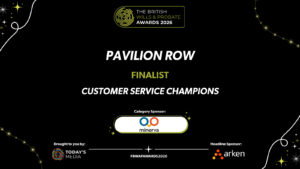
We’re delighted to share that Pavilion Row has been shortlisted for the British Wills and Probate Customer Service Champion award.
This recognition means a great deal to us because excellent customer service isn’t simply part of what we do. It’s the foundation of how we work.
People often come to us when they are making important plans for the future or dealing with a difficult period in their lives. We want every client to feel listened to, understand the advice they receive and know what will happen next.
We also appreciate the trust financial advisers and other professionals place in us when introducing a client. With the client’s consent, we keep the introducer informed and work collaboratively to support the relationship they have already built.
A shared commitment across our team
Our commitment to excellent service is embedded in our culture. We measure performance against client-service standards rather than billing or sales targets, and every member of our team takes responsibility for the client experience.
For us, excellent service means listening carefully, communicating clearly and giving honest advice. It means recommending the option that best meets the client’s needs, even when that is a simpler or less costly solution. It also means taking responsibility and putting things right if our service falls short of the standards we set ourselves.
We’re proud that 98% of our independent ReviewSolicitors reviews are five-star, with clients consistently commenting on the professionalism, responsiveness and care shown by our team.
However, we’ll never treat good service as something we have finished working on. We’ll continue to listen, learn and look for ways to improve.
We’re very proud of the whole Pavilion Row team and pleased to see their commitment recognised through this shortlist. Thank you to every client, family and professional partner who places their trust in us.
“Creating the culture that we want to work in is everyone’s responsibility.”
Recently, the team at Pavilion Row came together to discuss an important question: what kind of culture do we want to create and experience every day at work?
Those conversations led to the development of our Employee Charter. A document that sets out the standards, behaviours and values that we want to uphold as a team. Whilst the charter itself is important, what was even more valuable was the process of creating it.
Culture Is Built Together
Organisations often talk about culture as something that leaders need to create, manage or drive. Leadership certainly plays an important role, but lasting workplace culture cannot be imposed from the top down.
The strongest cultures are built collectively by people who care about how they work together. They develop through shared expectations, mutual respect and a commitment to supporting one another.
That is why the creation of our Employee Charter was such a meaningful exercise. Rather than being handed a set of values, colleagues had the opportunity to contribute their thoughts, experiences and aspirations for the workplace we want to build together.
Honest Conversations Matter
One of the most encouraging aspects of the process was the openness with which people engaged in the discussion.
Team members spoke candidly about accountability, respect, feedback, support and psychological safety. They discussed not only what they expect from others, but also the standards they want to hold themselves to.
These conversations reinforced an important truth: culture is not defined by words on a page. It is shaped by the behaviours we demonstrate every day and the choices we make in our interactions with colleagues.
More Than Policies and Procedures
Policies and procedures have their place, but they do not create culture on their own.
Culture is reflected in what we choose to accept, challenge and reinforce. It can be seen in how we communicate, how we support one another through challenges, how we give and receive feedback, and how we ensure that every member of the team feels respected and valued.
When people take ownership of these behaviours, positive culture becomes sustainable because it belongs to everyone, not just a leadership team.
Why It Matters
At Pavilion Row, we believe that a positive workplace culture is not just beneficial for our team, it directly benefits our clients as well.
When people feel respected, supported and psychologically safe, they are more confident in sharing ideas, raising concerns and collaborating effectively. This leads to better communication, stronger teamwork and ultimately a better service for the individuals and businesses who place their trust in us.
The Employee Charter gives us a shared understanding of the standards we expect from one another and helps ensure that our values are reflected not only in how we work together, but also in how we support our clients.
As we continue to grow, maintaining a strong culture will remain a priority. By taking collective responsibility for the workplace we create, we can build an environment where people thrive, develop their careers and perform at their best.
After all, culture is not something that happens to an organisation. It is something that every member of the organisation helps to create. And when people are empowered to do their best work, it leads to better outcomes for the clients who place their trust in us.
A copy of our Employee Charter can be found here.
We’re excited to announce that we are growing our Legal Support Team at Pavilion Row and we are currently recruiting for two fantastic opportunities.
Kickstarting your career in law? Our Level 3 Paralegal Apprentice role offers an excellent first step into the legal sector. You’ll earn while you learn, gaining hands-on experience in a supportive, professional environment while developing the technical skills and confidence needed for a long-term career in law.
We are also seeking a Legal Support Associate to join our team. This is a great opportunity for someone looking for a stable, long-term role in a professional office environment, where you can do meaningful, high-quality work, be part of a supportive team, and build specialist expertise without the expectation of continual progression into senior roles.
Both roles offer the chance to be part of a growing team that values quality, development, and doing things properly.
Full details, including how to apply, can be found on our careers page: Pavilion Row Careers
We are delighted to announce that we have appointed Will Morris as Director, following his five successful years at the company.
Joining Pavilion Row in 2021 as a Private Client Lawyer, Will quickly became an integral part of the legal team, and was later promoted to Head of Legal, overseeing the firm’s services across wills, trusts and probate.
Will has played a significant role in the development of Pavilion Row’s probate services, helping to expand the department while maintaining the firm’s focus on providing clear, expert guidance to clients navigating complex and often sensitive legal matters.
During his time at Pavilion Row, Will has completed his Society of Trust and Estate Practitioners (STEP) qualification and become a licensed practitioner through the Council for Licensed Conveyancers (CLC).
Angus Houston, Director at Pavilion Row, commented: “Will’s appointment is a prime example of the approach we take at Pavilion Row. We believe strongly in investing in our team and encouraging everyone to build long-term careers with the firm. Since joining, Will has demonstrated exceptional technical expertise and leadership, and he has played an important role in the development of our legal services. His progression to Director reflects both his contribution and the strength of the team we continue to grow in the business.”
Will Morris added: “I’m proud to be joining the board at Pavilion Row and working with my fellow directors to further expand the business. Since joining the firm, I’ve been encouraged to build on my professional experience and take on new challenges, which has been hugely rewarding. I’m looking forward to contributing to the continued growth of the firm while helping to uphold the high standards of service our clients rely on.”
Will joins Angus, Nicola Houston and Lorna Jessop on the leadership board, where they will lead the company as it enter its next stage of growth, whilst continuing to provide clients with exceptional support in wills, trusts, probate, estate administration and later‑life planning.
At Pavilion Row, supporting causes that matter to our team is incredibly important to us. This year, we are proud to be supporting Brain Tumour Research as our Charity of the Year.
To mark Wear A Hat Day, our team came together to take on an 8.8km sponsored walk to represent the 88,000 people currently living with a brain tumour in UK.
This is a cause particularly close to our hearts, as our colleague Phoebe Riggs lives day to day with a brain tumour. Taking part in this challenge was a meaningful way for us to show our support, raise awareness and contribute towards vital research.
With our most creative (and in some cases, silliest!) hats on — and joined by some of our families — we enjoyed a fantastic walk around Rother Valley Country Park. It was a great opportunity to come together as a team for such an important cause.
We’ve been incredibly touched by the generosity shown so far and are grateful to everyone who has supported us.
If you would like to contribute, you can visit our fundraising page here:
👉 https://www.justgiving.com/team/pavilion-row-charity-of-the-year-2026
We have plenty more fundraising activities planned throughout the year, so please do keep an eye out for updates as we continue to support this important cause.
As more estates fall within the scope of Inheritance Tax (IHT), the use of a Deed of Variation is becoming an increasingly important estate planning tool.
A Deed of Variation can help beneficiaries and advisers restructure how an estate is distributed after death, creating more tax-efficient outcomes and supporting long-term financial planning.
What is a Deed of Variation?
A Deed of Variation (sometimes called a “variation of will”) allows beneficiaries to change how they receive assets from an estate after someone has died.
For Inheritance Tax purposes, if certain conditions are met, the variation is treated as if it had been made by the deceased. This means it can be an effective way to reduce IHT liability or redirect assets in a more efficient way.
How a Deed of Variation helps reduce Inheritance Tax
Using a Deed of Variation for Inheritance Tax planning can provide several key benefits:
- Reduce the overall Inheritance Tax liability of an estate
- Prevent an inheritance from increasing a beneficiary’s future IHT exposure
- Pass wealth more efficiently to children or grandchildren
- Increase charitable gifts to benefit from the reduced 36% IHT rate
- Enable more flexible estate planning strategies
In many cases, a Deed of Variation can play a valuable role in broader estate planning strategies.
Using a Deed of Variation to create a trust
A Deed of Variation can also be used to redirect assets into a trust. This can be particularly useful where:
- Beneficiaries do not need immediate access to funds
- There is a need for asset protection or control
- Long-term financial planning and flexibility are priorities
Trust planning can also open up opportunities for ongoing financial advice and structured wealth management aligned with family objectives.
Key rules and time limits
Timing is crucial when using a Deed of Variation.
To be effective for Inheritance Tax purposes, the Deed of Variation must usually be completed within two years of the date of death.
Other important considerations include:
- All affected beneficiaries must agree to the changes
- The variation must be properly documented
- Tax implications should be carefully reviewed before proceeding
When should you consider a Deed of Variation?
A Deed of Variation may be worth considering if:
- An estate is likely to be subject to Inheritance Tax
- A beneficiary does not need the inherited assets
- There is a desire to pass wealth to the next generation
- Trust planning could improve long-term outcomes
Each situation will depend on individual circumstances, so professional advice is essential.
Deed of Variation factsheet
To help you understand how Deeds of Variation work in practice, we’ve prepared a concise guide covering the key rules and planning opportunities:
👉 Download our Deed of Variation factsheet
Get advice on Deeds of Variation and IHT planning
Deeds of Variation can be a powerful tool in the right circumstances, but they need to be used carefully to ensure they achieve the intended tax and planning outcomes.
If you would like to discuss a specific case or explore how a Deed of Variation could support your Inheritance Tax planning strategy, it may be worth speaking with a qualified adviser.
We are delighted to share that Ellie Denton has achieved Chartered Legal Executive status. Ellie’s hard work, dedication, and expertise have demonstrated outstanding commitment and skill throughout her work. We are proud to have her as part of the Pavilion Row team and look forward to her continued contributions to our clients and the firm.
Congratulations, Ellie, on this significant career milestone!
Budget in 2024 introduced a major change to Business Property Relief (BPR) with several iterations added since. These changes will affect the estate planning for many business owners. From 6 April 2026, full 100% relief will be limited to the first £2.5 million of business assets; any value above that will qualify only for 50% relief.
How will this effect previous planning done by Business Owners in their Will?
Many business owners with taxable estates have historically been advised to leave qualifying business assets to a Business Property Relief (BPR) trust on death. Under the current rules, this planning is highly effective:
-
- the transfer into the trust attracts no Inheritance Tax (IHT) due to the 100% BPR.
-
- the trustees can then sell or reinvest those assets into non-BPR qualifying investments.
-
- the value remains outside the beneficiaries’ estates for future IHT purposes.
This approach still works in principle, but the new BPR rules introduce a significant complication. Where the value of the business assets exceeds £2.5 million, any amount above that cap placed into the BPR trust will now trigger an immediate IHT charge at an effective rate of 20% (reflecting only 50% relief on the current 40% IHT rate).
As with other IHT liabilities, this tax will be due within six months of death and must be paid before a Grant of Probate can be issued. For many estates, this raises a practical problem: how will the trustees or executors fund the tax bill, particularly if the business cannot be sold quickly or if liquidity is otherwise limited?
Do those with BPR planning in their Will need to change it?
Possibly, depending on the value of the business and who is intended to benefit.
If the business is worth more than £2.5 million and the surviving spouse is the main beneficiary; it may be preferable to limit the amount passing into the BPR trust to £2.5 million (the level that still attracts 100% relief). Any excess can then pass directly to the spouse tax-free under the spouse exemption.
This essentially becomes a strategic choice:
-
- Pay 20% IHT on first death for amounts over £2.5 million going into a BPR trust, or
-
- Defer the tax to second death, where the same value might be taxed at 40% if the asset no longer qualifies for BPR by then.
You must also consider the impact on the overall value of the surviving spouse’s estate. Increasing their estate may reduce access to other IHT reliefs, such as the Residence Nil Rate Band, resulting
Next Steps for Business Owners?
We recommend that clients review any existing BPR planning in their Wills to ensure it remains effective under the new rules. This may involve:
-
- Assessing the value of business assets relative to the £2.5 million BPR cap.
-
- Considering whether a trust, partial trust, or direct spousal transfer is the most tax-efficient approach.
-
- Taking legal and financial advice to ensure their Wills align with their overall estate and succession planning objectives.
To assist, we have prepared a factsheet summarising the BPR changes and practical planning considerations. If you would like to review your existing arrangements, we are here to help.
We are pleased to share that three members of the Pavilion Row team — Cameron, Natalie, and Ellie — are continuing their professional development by studying for their next STEP module, Advising Families Across Generations, as part of their journey towards achieving full Trust and Estate Practitioner (TEP) status.
This next stage of study reflects both individual commitment and our firm-wide focus on maintaining the highest professional standards in estate and succession planning. We are particularly proud of Ellie, who has chosen to undertake this module while on maternity leave, demonstrating a strong commitment to ongoing learning and professional growth.
At Pavilion Row, we believe that continuous learning is fundamental to delivering high-quality outcomes for clients and supporting our people to develop long-term, fulfilling careers. Investment in respected qualifications such as STEP ensures that our team remains technically strong, up to date with legislative and planning developments, and well equipped to support clients through complex and often sensitive matters.
Ongoing professional development also strengthens the service we provide to professional referrers, reinforcing our ability to work collaboratively, align with adviser-led planning, and deliver consistent, trusted outcomes for clients.
We wish Cameron, Natalie, and Ellie every success as they prepare for their examinations and look forward to the continued contribution they make to the firm and to the clients we support.
At Pavilion Row, we believe in being transparent, acting with integrity, and always delivering positive outcomes for our clients. These principles shape how we work every day and they also guide how we give back.
One way we demonstrate this commitment is through our approach to client money. Any interest earned on estate funds held in our client account is always paid back to the estate. We do not have any opt-out clauses in our terms that allow us to retain this interest. This means all interest earned on your funds remains for the benefit of the estate and those inheriting.
Occasionally, however, small amounts of surplus interest arise that cannot be attributed to a specific client or estate. While firms are permitted to retain these funds, we choose not to. Instead, we donate these surplus amounts to a nominated charity each year.
For 2026, we are proud to announce that our chosen charity is Brain Tumour Research.
This is a cause particularly close to our hearts. One of our colleagues, Phoebe Riggs, lives day to day with a brain tumour, and her experience has brought home to all of us the vital work this charity does supporting patients and families, funding research, and raising awareness.
As part of our ongoing commitment, Pavilion Row has also established a staff-led Charity Fundraising Committee, chaired by Phoebe. The committee’s role is to plan and organise fundraising activities throughout the year to support Brain Tumour Research and help make a meaningful difference.
We’re looking forward to sharing details of upcoming events and initiatives so please watch this space.
We’re proud to have played a pivotal role in shaping the Advanced Probate Exemption with the Council for Licensed Conveyancers – regulating property and probate lawyers. Rightly recognising the depth and rigour of the STEP – Advising Families Across Generations qualification, it gives STEP professionals a clear pathway to authorised status.
It aligns with one of our key priorities at Pavilion Row: supporting employee growth and ensuring everyone has the opportunity to build a rewarding career, whatever their background.